Peter Solomon
The Lost SymbolPeter Solomon is a prominent historian, scientist, philanthropist, and leader in Freemasonry whose guarded knowledge makes him both the object of a search and the moral center of a family reckoning. To Robert Langdon, he is a longtime mentor and trusted friend; to Mal’akh, he is the father whose past choice helped shape a son’s ruin. Peter’s story joins the mystery of the Masonic Pyramid to the consequences of that choice, ending with his insistence that the Lost Word is not merely a legend but a source of human transformation.
Identity and Background
At fifty-eight, Peter belongs to a wealthy and influential family whose name appears on buildings and universities across the country. He inherited its mantle young after his father’s death and went on to occupy positions of public authority. At the point when Langdon is summoned to Washington, Peter heads the Smithsonian Institution. His prominence is matched by a quiet manner: Langdon recalls his gentle gray eyes and humility rather than the family fortune or status. Langdon sometimes teases him about having attended Yale, which he regards as the lesser university in their friendly academic rivalry.
Peter’s Masonic standing is more than a private interest. He leads the Thirty-third-Degree Supreme Council, the governing body of the Scottish Rite in America, and holds the highest-ranking official position within that body. The thirty-third degree is an elite honor, awarded by invitation rather than attained automatically through the preceding degrees. Peter therefore occupies a position of substantial responsibility within a tradition organized around degrees, restricted knowledge, and the careful custody of its symbols.
His views on the Ancient Mysteries are not simply antiquarian. He believes that old traditions preserve knowledge with the potential to change human understanding, even when that possibility strains Langdon’s academic skepticism. Peter’s confidence in the power of symbols and hidden teachings gives the novel’s riddle its stakes: for him, the object in his care is not merely valuable property but dangerous knowledge that must be kept from people he considers unworthy of it.
Friendship with Robert Langdon
Peter’s bond with Langdon begins when Langdon is a sophomore. After encountering Peter’s intelligence and character, the young student writes him a thank-you letter without expecting a reply. Peter answers, and the correspondence becomes the beginning of a lasting friendship. Nearly thirty years later, Langdon thinks of Peter as the person he least wants to disappoint. Peter has also helped fill the emotional absence left by Langdon’s father, making their connection at once intellectual and deeply personal.
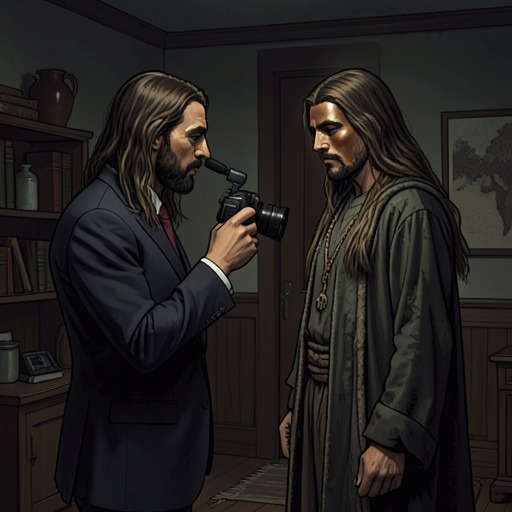
That trust becomes consequential when Peter visits Langdon at Harvard University before dawn to ask a favor in person. He gives Langdon a small, heavy, cube-shaped package wrapped in faded brown paper and tied with twine. Peter explains that he inherited the object and no longer feels safe keeping it at home or in his office. A bank would introduce paperwork and employees; he wants instead to rely on a friend he knows can keep a secret. He asks Langdon to safeguard it without requiring him to accept Peter’s claims about what it can do.
Peter describes the object as a talisman capable of bringing order from chaos, an idea Langdon recognizes as a Masonic axiom but cannot accept as a literal power. Peter knows that Langdon’s skepticism makes belief unlikely, so he asks for trust rather than agreement. He warns that the object would be dangerous in the wrong hands and says that powerful people want to take it. His choice of a friend outside the Masonic inner circles is thus both an act of confidence and a way to place the secret beyond those who might exploit their institutional access.
Leadership, Secrecy, and the Pyramid
Peter’s position helps explain the significance of the Masonic Pyramid and its capstone. The pieces have been kept apart, in keeping with the obligation to protect the Ancient Mysteries from people with unworthy motives. Peter’s friend Warren Bellamy suspects that Peter selected Langdon precisely because Langdon is not a Mason and therefore stands outside the circles that have previously targeted the pyramid. The arrangement turns friendship into a form of guardianship: Langdon’s lack of membership, initially a reason to doubt his role, becomes the reason Peter trusts him with it.
Peter’s authority also reaches into the hidden spaces of Washington. A notation by the Architect of the Capitol identifies SBB XIII as private and reserved for Peter’s use. The discovery unsettles Langdon and those investigating the underground space, since it suggests that Peter has access to a concealed place beneath the Capitol as well as knowledge of the pyramid. The evidence ties his public stature to a private custodianship, but does not make the secret simply a matter of institutional power: the object’s protection depends on personal trust and on keeping its components separate.
When Mal’akh abducts Peter, he uses Peter’s hand as a message and a clue. Langdon recognizes the familiar ring and hand; the fingertips bear new tattoos, including a crown and a star. Their arrangement points toward the mystery surrounding the hand and the pyramid, while the fact that Peter is still alive makes the discovery more alarming. The hand becomes an emblem of Peter’s captivity: his body has been made part of a symbolic system that Langdon must interpret, and the signs intimate that the captor wants knowledge rather than simple concealment.
Fatherhood and the Past with Zachary
Peter’s most consequential private decision concerns his son, Zachary Solomon. He had presented Zachary with a choice between wealth and wisdom; Zachary chose wealth, and the decision began a chain of events that led to his imprisonment in Soganlik Prison. When Peter visited him there, prison officials indicated that money could speed the process of securing his release. Peter did not take the offered route. Zachary was subsequently found dead in his cell, and Peter returned from Turkey with his son’s casket to bury him in the family cemetery. The prison administrator disappeared, as did the fortune Zachary had transferred to a numbered account.
The story initially presents Zachary’s death as a devastating loss that Peter could not undo. Mal’akh later reveals that Peter could have saved his son, turning the prison episode into a charge of abandonment. Mal’akh remembers being present when Peter made his decision and regards it as the moment Zachary’s life ended and Mal’akh’s identity began. He invokes the choice between wealth and wisdom, Peter’s expectation that his son would join the Masons, and Peter’s failure to bring him home. The accusations expose how Peter’s effort to impose a moral lesson became, in his son’s memory, a rejection with lasting consequences.
That reckoning reaches Peter when Mal’akh finally identifies himself as Zachary. Peter had imagined what his lost child might have become, but the man before him is now associated with the deaths of Isabel Solomon and the people Peter loves. Recognition does not erase the distance between the infant Peter remembers and the son who has returned as an enemy. Instead, it forces Peter to confront both their kinship and the harm Mal’akh has done. Their relationship is therefore more than a concealed identity: it is the unresolved bond between a father’s decision and a son’s transformed sense of injury and revenge.
Captivity, Resistance, and the Ending
Mal’akh keeps Peter captive to obtain the location of a secret staircase and complete his pursuit of the pyramid’s meaning. Peter is brought before the assembled Masonic Symbolic Pyramid and its capstone, which Mal’akh presents as the completed symbol. When Peter asks after Katherine Solomon, Mal’akh threatens her life to force his cooperation. Peter pleads for help for his sister, but Mal’akh continues to demand the staircase’s location. The threat makes Peter’s choices immediate: his own safety and the secret are weighed against the possibility of saving Katherine.
Peter initially gives Mal’akh a false answer, claiming there is a staircase beneath the building and promising to lead him there after help is sent to Katherine. When Mal’akh sees through the deception, Peter refuses to yield the knowledge on the captor’s terms. He tells Mal’akh to save Katherine and learn the truth, or kill them both and remain ignorant. This is resistance without physical power: Peter cannot control his captivity, but he can refuse to make the secret available through coercion.
After Mal’akh’s death and the immediate crisis, Peter is again present as a teacher to Langdon. Facing the skeptical friend who once received the cube-shaped package, he explains that the Lost Word is real and has the power to transform humankind by unlocking the Ancient Mysteries. Langdon struggles to accept the claim, while Peter speaks with calm assurance. The exchange brings their long relationship back to its defining tension: Peter asks Langdon to trust what he cannot yet believe. His final significance rests in that tension, as a keeper of knowledge who relies not on rank alone but on friendship, judgment, and the possibility that human understanding can change.